Allison and Zelikow’s three models from ‘Essence of Decision (1991)’ originally used to explain the Cuban Missile Crisis can be successfully adapted to explain more recent events, such as the Invasion of Iraq (2003).
The Invasion of Iraq in 2003 was an international phenomenon similar to that of the Cuban Missile Crisis. Although the potential for a nuclear apocalypse was highly unlikely in Iraq, the situation nevertheless is an example of agents and structures influencing and conflicting with each other. Alison and Zelikow in their book, Essence of Decision (1999), use a set of three models to explain the Cuban Missile Crisis and the reasoning and structures behind the end result. Allison and Zelikow, in their analysis of the Cuban Missile Crisis, found that organisational behaviour and governmental politics played a more important role in determining the outcome than actors acting rationally. Arguably, they would suggest that the same applies for the 2003 Invasion of Iraq, however, this essay argues that all three models are of equal worth as each brings a unique feature and consequently variety to explaining phenomena. Thus this essay proposes that all three of Allison and Zelikow’s models; rational actor, organisational behaviour and governmental politics, can effectively present applicable reasons for the occurrence of international phenomena but a combinational approach would lead to a more accurate explanation.
The first model, which was widely established, is the rational actor model, where actors within a governing body act unitarily and rationally on the basis of perceived and agreed national interests (Allison & Zelikow, 1999). Clearly, rational theorists such as Milton Friedman (1962) and Charles Glaser (2010) disagree with Allison and Zelikow’s suggestion that rational models are ineffective in comparison to organisational behaviour or governmental politics, who argue there is fasifiability of rational thought and the often inability to prove success (Allison & Zelikow, 1999). Friedman in contrast, (1962) suggests that rational expectation theories do not describe reality but rather an accurate prediction based upon rational action and maximisation of utility. It is also worth noting that Chao Jing, William Kaempfer and Anton Lowenberg (2001) suggest that rational actors are influenced by markets, an argument Michael Parenti (2002) agrees and associates with the Invasion of Iraq (2003).
Organisational behaviour or bureaucratic behaviour is the second model Allison and Zelikow propose. This posits that the choices available to contextually current policymakers are framed within the boundaries of previously developed decisions and goals, established by former policymakers. Thus policymakers are contained within a structure which persists despite changes to administration and personnel (Allison & Zelikow, 1999,143). Organisational Behaviour and bureaucratic based literature such as Peter Blau’s and Sak Kukalis’s work, theoretically support Allison and Zelikow’s argument that problems within governmental bureaucratic structures can impede, create or change the final outcome of policy and decision making (1956 & 1970)(1989). Martin Smith (2008) supports this argument as he noted that “…limitations on bureaucratic politics within the second Bush administration…” prevented higher echelons in the Bureaucratic arena from, “…work[ing] effectively in exercising core functions of challenge and debate.” (2008:91).
While the organisational behaviour model primarily concerns the process of decision making, the governmental political model instead focuses upon the political actors and their structurally defined role. Essentially, this model argues that decisions emerge as a result of political bargaining for personal reasons by key individuals and groups within a government structure (Allison & Zelikow, 1999:255). Governmental political literature by theorists such as Erik Lundsgaarde (2007) and Michael Laver (2008) suggest – as John Dryzek (2012) discussed – that international decisions are caused by, “…international governmental organizations seeking ‘legitimation’ for their activities…” (2012:103). Richard Schutz further exemplifies governmental politics through his analysis of governments and educational research in 1972, he found that, “Government politics now permeates both domains….” (1972:1) for political success. Thus policy according to this model is created by the ‘pulling and hauling’ within politics (Allison & Zelikow, 1999:255).
There is also significant academic criticism of these three models. Allison, personally, criticises the rational actor model and its emphasis on the unity nature of states, he argues that the state – or government in a US context is, “a vast conglomerate of loosely allied organizations, each with a substantial life of its own” (Allison & Zelikow, 1999, 143). Contrastingly, criticism of Allison and Zelikow’s preferred models of organisational and governmental politics models focuses around the underestimation of the role of hierarchy in certain governments, such as the United States or Iraq (Krasner, 1972:159) (Hermann, 2001:87)(Smith, 2008:95)(Jakobsen, 2009:667)(Bernstein, 2000:159). Bernstein (2000, 159), for example, suggests that the role of the president is not that of simply another actor in the ‘pulling and hauling’ within governmental bureaucracy. Rather, he occupies a unique role as the constitutionally and actual role as the decider (Bernstein, 2000:157). Similarly, he is an actor who is arguably in control of his bureaucratic environment because he is capable of appointing senior advisers and their main subordinates. Thus he is not constrained by an impersonal bureaucracy (Krasner, 1972:168), but rather wields more control and influence than anyone else.
Synthesisation of analysis, is an important notion when analysing international phenomena because rarely is there a single notion or theory that provides all the answers or asks all the right questions. Although a seemingly easy and arguably logical step, synthesisation of analysis is widely debated. Andrew Moravcsik, a supporter for synthesis, suggest that …”theories ought to be treated as instruments to be subjected to empirical testing and theory synthesis…”(2003,131). His critics, such as Friedrich Kratochwil, Yosef Lapid, Iver Neumann, and Steve Smith (found in Moravcsik, 2003), disagree with theory synthesis because “…nothing, in particular neither empirical disconfirmation nor the need to combine theories to explain complex real-world events, should be permitted to dampen theoretical pluralism.” (Moravcski, 2003:135). Thomas Paster (2005:147), contrastingly, agrees with Moravcsik and has had reasonable success combining rationalism and constructivism to explain the Voluntarist Policy Coordination in the EU.
Applying Alison and Zelikow’s models – Rational Actor, Organisational Behaviour and Governmental Politics – to three key questions aimed at exploring the international moments before the Invasion of Iraq (2003); Why was Saddam Hussein’s regime ambiguous about their possession of ‘Weapons of Mass Destruction’ (WMD); why did the United States (US) respond with an aggressive invasion; and why did the US feel that ignoring the United Nations (UN) and the international community was appropriate? This approach is similar to the one Graham Alison followed in his theoretical application of his models to the Cuban Missile Crisis and thus expresses the models effectiveness in analysing international phenomena.
Leading up to the 2003 invasion, Saddam Hussein played brinkmanship with the United States (Jakobsen,2009:664)(Smith,2008:135). After the first Gulf War of 1991, Iraq was obliged by the United Nations (UN) to dispose of its chemical and biological weapons and nuclear capability plans (United Nations Resolution 679, 1990). The UN followed this through with inspections by the Special Commission. The UN Special Commission, however, in 1998 were thrown out, under allegation by Hussein’s regime of spying for the US. This prompted ‘Operation Desert Fox’, an intensive bombing campaign that targeted installations that could potentially produce, store, maintain or deliver Weapons of Mass Destruction (United States Department of Defense). Weapon inspection were allowed back into Iraq following Resolution 1441 by the UN security council, which gave Iraq’s leaders an ultimatum to comply or face further consequences (United Nations Resolution 1441, 2002).
The Saddam regime’s ambiguity concerning whether they had a stockpile of ‘Weapons of Mass Destruction’ (WMD) according to the rational actor model was a completely rational action. The key component of the rational actor model is that agents act rationally. In this case it seems unlikely that Saddam and his regime were acting rationally, however, Harsanyi (1986) suggests that whether or not an actor behaves rationally is not directly relatable to the resulting outcome. Rather, an actor behaves rationally if there are consistent sets of values or payoffs over all logically potential outcomes and chooses the strategy that best serves these interests. Thus rationality does not suggest that all actors have a common value system. Instead, it simply implies that each actor pursues their own value system consistently (Dixit, 1999:27). Realist theory suggests that in anarchic states security is a key consideration when acting on a domestic and international level (Waltz, 1979, 126). Therefore, it is reasonably to suggest that Saddam’s regime wished to remain powerful within the region to deter uprisings and threats from ‘archrival’ Iran and other Sunni neighbours. Tor G. Jakobsen & Jo Jakobsen (2009) present three clear rational options that Saddam’s regime had (Appendix A); prove Iraq had no WMD’s and risk losing domestic and regional dominance; let it be known Iraq has WMD’s and risk violation of UN Resolution 687 and face Western intervention; or act WMD ambiguous and preserve Iraq’s power as Western nations would unlikely intervene, while domestic and regional issues would be stalled, without proof (Jakobsen, 2009:665). Thus Saddam’s regime’s actions according to the rational actor model were based upon lack of knowledge that the US would invade without proof of WMDs and due to domestic and regional necessity.
The US decision to invade Iraq, according to the rational actor model, similar would indicate the move as the ‘best’ decision. According to this model the US had a variety of options to choose from in their response to the Hussein Regime’s ambiguous nature and refusal to declare themselves devoid of WMDs. These choices can be broadly split into three categories; diplomacy, covert and overt (Livingstone, 2009)(French, 2003:7). Diplomatically, the US could have followed the UN in their continued diplomatic response which probably would have led to no active military engagement, support from the international community and no potential for a WMD disaster. Oppositely, however, this process would undoubtedly take time and there was potential for no change. A coup or regime change is not a new concept to US foreign policy. Since 1898 where it, “…intervened in Cuba, raising its flag over the island nation and establishing a military government.” the US has been, “…ousting leaders or inciting revolts in Panama, Venezuela, Haiti, the Dominican Republic, Nicaragua, Honduras, Guatemala, Brazil, Bolivia, Chile, Grenada, and El Salvador, to name only a few.” (LAP Collective: in French, 2003) for political reasons (Livingstone, 2009)(French, 2003:7). A coup, however, could lead to potential instability within the reason, take a long time or even fail. The final category, was the rationally chosen invasion. An invasion would essentially guarantee the removal of the Hussein regime and any WMDs they may have, while also ensuring a friendly puppet government would be installed. The only negatives with this action from a rational actor model perspective would be the potential for WMDs (if they existed) to be used if the US could not disable them and the outcry from the majority of the international community including the UN. Thus from a rational agent perspective, to remove Hussein’s regime and any potential WMDs an invasion would have the highest chance of success.
Ignoring most of the international community including the UN can also be argued as a predictable rational action by the United States. The rational actor model would argue that the US decision-makers would have unitarily agreed that the removal of Hussein’s regime was the best choice of action out of the available rational decisions and thus ignoring the international community including the UN was a necessary requirement in order to complete the task and prevent Iraq from preparing itself or developing more WMDs (Glaser, 2012)(Cramer, 2012)(Nathan, 2008:147-164). This decision would have been chosen based upon the US belief that Hussein regime had WMD, refused to disarm them and that there was potential for them to be used against Americans. Thus the most appropriate decision was to strike as soon as possible, with or without complete international or UN approval. Alternate options, such as listening to the UN or attempting to prove Hussein’s regime had WMDs would require too much time and risk the American public.
The organisational behaviour model can similarly explain these three questions. The main organisations according to this model in regards to why Hussein’s regime chose WMD ambiguity were the Iraqi military chiefs and the Iraqi intelligence. These organisations, however, would not be advice givers, but more likely yes-men, and thus would have proposed whatever would support Hussein’s status quo (Jakobsen, 2009). Similarly, to the reasoning of the rational actor model the organisational behaviour model would suggest that WMD ambiguity would prevent local and regional conflict, however, this model further suggests that this was due gravitation towards limiting short-term uncertainty. The final and arguably most important reason, according to the organisational behaviour model, that Hussein’s regime chose WMD ambiguity would be because the regime had faced no real challenges since the first Gulf War, despite violating numerous UN resolutions and the US creation of the Iraq Liberation Act of 1998 (Jakobsen, 2009)(Parenti, 2002). Thus the pre-existing plan of ‘cat and mouse’ that had been used since the 1990s could be reused for similar success.
The organisational behaviour model would explain the US choosing to invade Iraq rather than continuing diplomatic actions as a pre-existing structure embedded within the US government. As raised within the rational actor model, the US is not new to the concept of creating either covertly or overtly regime change (Thyne, 2010:449) (Livingstone, 2009)(French, 2003). Specifically in regards to Iraq this pre-existing plan began under Bush Senior’s administration during the first Gulf War, after which the Central Intelligence Agency (CIA) argued that the US need not act further, because Hussein’s regime should implode within the year (Smith, 2008:97). Although, this did not occur the notion of Hussein’s regime being removed remained throughout the Clinton administration and arguably formalised through the signing of the Iraq Liberation Act (1998) (Smith, 2008). Likewise, the CIA, which was apparently handling the intelligence gathering, failed to properly provide accurate evidence of WMDs due to bureaucratic problems such as satisfying the status quo (Cramer, 2012). Thus the organisational model would argue that the invasion of Iraq was less a decision than a pre-determined outcome.
The ignorance of the UN and majority of the international community based upon this model would argue the pre-existing argument entrenched within the US government that the UN is no more than a platform for the member states to arbitrate, not a body with any authority. Randy Scheunemann, a former advisor to US Defense Secretary Donald Rumsfeld, summarises this belief as, “I think it is outrageous for the Secretary-General, who ultimately works for the member states, to try and supplant his judgement for the judgement of the member states.”(In: Brooks, 2005:530). The UN thus for the US is nothing more than a platform to exercise its ‘soft power’ (Shawcros, 2004)(Lundsgaarde, 2007)(Scott, 2007:67-87). The primary organisations delegated tasks surrounding this phenomenon, such as the CIA and the military, similarly, are not exactly instruments of ‘soft power’. The former questions conclusion that the invasion of Iraq was a pre-determined outcome also indicates that this question of conforming to the UN and significant international thought was an almost irrelevant question.
The governmental politics model suggests that action is only taken after either extensive political negotiation or engagement between decision-makers or due to a leader’s certainty (Hermann, 2001:83-131). In the case of Saddam Hussein’s regime and their decision to act WMD ambiguous, Saddam Hussein arguably chose not to consult (or only go through the motion) as he was surrounded by yes-men who feared his wraith (Jakobsen, 2009:664). Any alternative input would have been framed within Saddam’s decision to act WMD ambiguous or arguably completely ignored (Laver, 2008).
The governmental politics model reasoning behind the invasion of Iraq in contrast to the Iraq WMD ambiguity question only appears more complex due to the greater diversity of decision-making actors. These actors were still entrapped within the decided structure of doing something about Iraq, there would arguably have been no ‘do nothing or let the UN handle it’ responses due to George Bush’s implicit decision to act upon Iraq’s ambiguity (Strein, 2008:105). Correspondingly, Bush’s advisors were mostly supporters of neoconservative ideas (Khong, 2004). Neoconservative ideas according to Homolar-Riechmann (2009:183) and Khong (2004:256) are built upon four pillars, moral clarity in foreign policy; preserving the military supremacy of the US; readiness to use this military power to achieve goals; and a distrust of international institutions. Paul Wolfowitz and Vice President Cheney, two very close ‘friends’ of Bush and arguably neoconservatives, exerted pressure on ‘sceptics’ such as Colin Powell and George Tenet who were advocating for alternative approaches, ultimately resulting in an almost unanimous decision from the advisors to invade (Khong, 2004:251). Thus even if Bush was leaning towards a peaceful solution according to the governmental politics model the result would have still been an invasion due to influence exerted by key influential members and their clout.
Similarly, Bush’s ultimately implicit decision to act against Iraq combined with the pressures exercised by major neoconservative strategic agents within his advisory group would suggest that ignoring the UN and the majority of the international community was a predestined decision. Additionally, the decision-makers within the Bush administration would be looking at the opinions of the American public, to an extent. As the expansionist, neoconservative voice was by and large that of the American public, the Bush administration, would have ignored the UN and the international community in the pursuit of political success (Scott, 2007:67)(Khong, 2004)(Janis, 1982). Finally, the Congress and the Senate passing a law authorizing the use of armed forces against Iraq (Jakobsen, 2009), may have further influenced the Bush administration to overlook the UN Security Council’s authorisation.
The three ‘lenses’ or models outlined by Allison and Zelikow (1999) can successful enable conclusions to be drawn concerning the issues surrounding the 2003 invasion of Iraq. All three models can successfully answer the three questions regarding the explicit steps that occurred before the invasion: Saddam Hussein’s regime acting WMD ambiguous, the US decision to invade Iraq, and the US’s decision to ignore the UN and the wider international community. The models, however, have different implications if applied individually. The rational actor model would suggest that each situation is deeply entwined from the decisions made in the previous situation. For example, Hussein’s regime chose to act vague in regards to whether it had or was producing WMDs. The US chose to invade Iraq because it refused to declare it had no WMDs and had to act quickly, to reliable ensure none remained. This resulted in the US coming to conflict with the UN and most of the international community, but chose to ignore these groups in favour of choosing an action that had the highest chance of success. The organisation behaviour and governmental political models in contrast are influenced less by former situations then they are by the structures surrounding the situation. This would hence indicate that the 2003 invasion of Iraq by the ‘Coalition of the Willing’, lead by the US, was a predetermined situation that would occur eventually regardless of the Hussein regime’s response to Resolution 1441 due to neoconservative influences and or pre-existing structural influences developed during the first Gulf War. The rational actor model, comparatively, would advocate the invasion of Iraq by the ‘Coalition of the Willing’ may not have ever occurred if Hussein’s regime had complied with Resolution 1441 (Jakobsen, 2009)(Harsanyi, 1986).
A synthesisation of these models (Moravcsik, 2003) based upon contextual appropriateness arguable leads to better explanations. In regards to why Hussein’s regime chose WMD ambiguity, a synthesisation of the rational actor and organisational behaviour models provide a more thorough justification. The governmental politic model in this situation is less effective because it does not comprehensively allow a decision to be made purely from an individual’s rationale. Hussein’s regime, according to Jakobsen (2009) and Cramer (2012) was strictly ‘under the thumb’ of Saddam Hussein and although other figures may influence decisions, the advisors surrounding Saddam Hussein were primarily ‘yes-men’. Thus the decision of ambiguity was primarily made by Saddam Hussein based upon information provided by his organisations. As the primary actor, his main objective was the security of his position and thus his state (Jakobsen, 2009) (Harsanyi, 1986)(Nathan, 2008). His former decision of ambiguity had to date effectively juggled ensuring local and regional compliance while preventing extensive international intervention. Thus based upon his information and his intended goals, WMD ambiguity seemed the most effective course of action and was thus chosen.
In relation to the US response to this situation the organisational behaviour and governmental politics models provides a superior rationalization, ironically, than the rational actor model. In this circumstance, it is evident that more than a single unified government or voice influenced the decision to aggressively invade Iraq (Khong, 2004)(Homolar-Riechmann, 2009)(Laver, 2008)(Cramer, 2012). Iraq being set in the agenda since the first Gulf War further supports the evidence that George Bush junior was pre-inclined to remove Saddam Hussein from power and the WMD issue and organisations supporting the status quo presented an opportunity to fulfil this inclination (Khong, 2004). The unanimous decision from the Bush administrations advisors and the ‘conversion’ of neoconservative sceptics such as Powell indicates that politicking clearly was active. These components combined effectively clarify the aggressive response of the Bush administration, more so than the rational thought that an invasion would maximise success.
Finally, the US’s decision to blatantly ignore the UN and the majority of the international community is, once again, best explained through the organisational behaviour and governmental politics models. As with the previous circumstance, a multitude of forces and structures such as neoconservative aggressive thought within the Bush administration and personal vendettas against Hussein (Hermann, 2001) ultimately influenced the decision-makers.
Allison and Zelikow’s models can individually give reasons for the decisions in certain situations that developed into the 2003 invasion of Iraq. Theory synthesisation, however, provides more varied and appropriate explanations based upon contextual appropriateness. These models effectively work together as rational thought can be applied within the boundaries of structural influences if approached from a contextual level and a variety of structural forces can cooperatively frame and influence a decision. Therefore, although Saddam Hussein’s ambiguity was primarily chosen based upon rational reasoning of a contextual situation, Allison and Zelikow’s models combined through synthesisation suggest that the 2003 invasion of Iraq was decided by the Bush administration as soon as Hussein’s regime supplied them with a sufficient excuse regardless of international opinion, due to bureaucratic and personal political agendas.
Appendix A
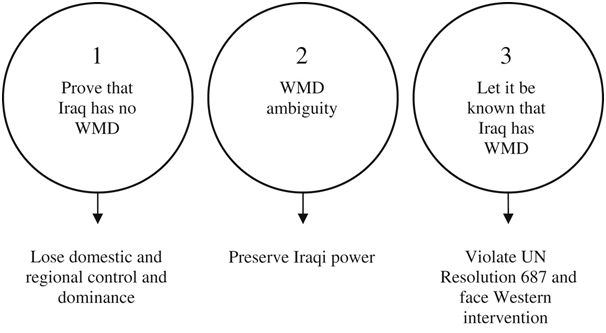
In: Jakobsen J & T. (2009). The Game: A Rational Actor Approach to the US-led invasion of Iraq, 2003. Strategic Analysis. Vol 33:5. 664-674.
Bibliography and References
Bibliography
Gaddis, J. 1997. We Now Know: Rethinking Cold War History, New York, Oxford University Press.
Schlesinger, A. 1965. A Thousand Days: John F. Kennedy in the White House.
Schlesinger, A. 1965. The MacArthur Controversy and American Foreign Policy.
References
Allison, G. and Zelikow, P .1999. Essence of Decision: Explaining the Cuban Missile Crisis, Longman: 2.
Bernstein, B. 2000. Understanding decision-making, US foreign policy, and the Cuban missile crisis. International Security, Vol 25:1, 134–64.
Blau, P. 1956. Bureaucracy in modern society. New York, NY, US: Crown Publishing
Blau, P. 1970. “A Formal Theory of Differentiation in Organizations” New York, NY, US: Crown Publishing
Cramer, J and Thrall, T. 2012. Why did the United States invade Iraq? US: Routledge; 1.
Dixit A and Skeath S. 1999. Games of Strategy, W.W. Norton, New York and London, , 27–28.
Dryzek, J. 2012. Global Civil Society: The Progress of Post-Westphalian Politics.
Annual Review of Political Science, Vol. 15: 101 -119.
French, J. 2003. Why Talk? The U.S. Invasion of Iraq. Latin American Perspectives, Vol30:4, 7-9.
Friedman, M. 1962. Capitalism and Freedom. US: University Of Chicago Press.
Glaser, C. 2012. Rational Theory of International Politics: The Logic of Competition and Cooperation. Millennium – Journal of International Studies. Vol. 40: 3. 679-681.
Harsanyi J. 1986. ‘Advances in Understanding Rational Behavior’, in Jon Elster (ed.), Rational Choice, Basil Blackwell, Oxford, 82–108.
Hermann, M. 2001. Who Leads Matters: The Effects of Powerful Individuals. International Studies Review, Vol 3:2, 83-131.
Homolar-Riechmann, A. 2009. The Moral Purpose of US Power: Neoconservatism in the Age of Obama. Contemporary Politics, Vol15:2, 179-196.
Janis, I. 1982. Groupthink: Psychological Studies of Policy Decisions and Fiascoes. Houghton Mifflin Company, Boston. 2nd ed.
Jakobsen J & T. 2009. The Game: A Rational Actor Approach to the US-led invasion of Iraq, 2003. Strategic Analysis. Vol 33:5. 664-674.
Khong, Y. 2004. Neoconservatism and the domestic sources of American policy: the role of ideas in Operation Iraqi Freedom. In: Dunne, Tim et al. (eds.), Foreign Policy: Theories, Actors, Cases, 251-267.
Krasner, S. 1972. Are bureaucracies important? (or Allison Wonderland). Foreign Policy, Vol 7, 159–79.
Kukalis, S. 1989. The Relationship Among Firm Characteristics and Design of Strategic Planning Systems in Large Organizations. Journal of Management. Vol. 15:4. 565-579.
Livingstone, G. 2009. America’s Backyard : the United States and Latin America from the Monroe Doctrine to the War on Terror / Grace Livingstone. US: Zed Books.
Lundsgaarde, Erik. 2007. The domestic politics of foreign aid: societal interests, institutions, and governmental politics, University of Washington. Environmental Sciences and Pollution Management. Vol. 68:12.
Michael Laver, 2008, Governmental Politics and the Dynamics of Multiparty Competition. Political Research Quarterly. Vol. 61: 3. 532-536.
Moravcsik, A. 2003. Theory Synthesis in International Relations: Real Not Metaphysical. International Studies Review. Vol. 5:1. 131-136.
Nathan, J .2008. The Retreat from Westphalia: Iraq and the “Shadow of Power” Defense and Security Analysis, Vol. 24:2. 147-164.
‘Operation Desert Fox’, United States Department of Defense, at http://www.defenselink.mil/specials/desert_fox/ (Accessed October 4, 2008).
Parenti, M. 2002. Global Intervention: The Case of Iraq. Nature Society and Thought. Vol. 15:4.
Paster, T. 2005. Combining Rationalism and Constructivismin: Explaining Voluntarist Policy Coordination in the EU.
Schutz, R. 1972. Educational Research and Governmental Politics. Educational Researcher. Vol 1: 1-2.
Scott, S. 2007. Does Legality Really Matter? Accounting for the Decline in US Foreign Policy Legitimacy Following the 2003 Invasion of Iraq. European Journal of International Relations. Vol 13:1. 67-87.
Shawcross, W. 2004. Allies; the U.S., Britain, Europe, and the war in Iraq. US: Atlantic.
Smith M. 2008. US bureaucratic politics and the decision to invade Iraq. Contemporary Politics. Vol14:1. 91-105.
Thyne, C. 2010. Supporter of Stability or Agent of Agitation? The Effect of US
Foreign Policy on Coups in Latin America, 1960—1999. Journal of Peace Research. Vol.47:4. 449-461.
‘United Nations Resolution 1441’, adopted by the Security Council at its 4644th meeting on November 8, 2002, at http://www.state.gov/p/nea/rls/15016.htm (Accessed January 20, 2009).
‘United Nations Resolution 678’, adopted by the Security Council at its 2963rd meeting on November 29, 1990, at http://www.fas.org/news/un/iraq/sres/sres0678.htm (Accessed October 4, 2008).
Waltz, K. 1979. Theory of International Politics, McGraw-Hill, New York, 126.